Submission Guidelines
Item |
Description |
|---|---|
| Key Findings | Authors should clearly highlight the key findings of the paper and explain their significance to the field in their cover letter. |
| Language | The journal accepts manuscripts written only in English. |
| Copyrights | Copyrights for articles are retained by the authors, with first publication rights granted to the journal. Authors have rights to archive and distribute their own articles after publication in SLJIHS. The Journal is not responsible for subsequent uses of the work. |
| Submission Format | Manuscripts should be prepared in Microsoft Word and submitted online. Editing Rights: The editors reserve the right to edit or otherwise alter all contributions; however, sub-editors will send proof to the corresponding author for approval before publication. |
| Author Declarations | Authors should declare that the manuscript has been reviewed and approved by all authors and the relevant authorities where the work was conducted. |
| Ethical Approval | Where applicable, an official ethical approval letter should be submitted together with the manuscript. |
| Word Count | Track application status through the portal.Original Artical : 4000-6000
Review Aritcal : 3000-6000 Case Report : 1500-3000 |
All material submitted is assumed to be submitted exclusively to the journal unless otherwise stated. Submissions will be returned to the author for amendment if presented in the incorrect format.
Keywords
Authors are required to provide 3-5 keywords relevant to the content of the manuscript during the submission process. This assists in the identification of the most suitable reviewers for the manuscript. Keywords should be submitted with the abstract.
Manuscript Format
The manuscript must be submitted as a Microsoft Word document. PDF is not accepted. Click Here
The manuscript should be presented in the following order:
Item |
Description |
||||||||||||
|---|---|---|---|---|---|---|---|---|---|---|---|---|---|
| Title Page | Should include the authors’ names and affiliations. Author names should be formatted as Surname followed by initials (e.g., Perera A.B.C). Affiliations should be listed in the order of Department/Institution, City, Country. | ||||||||||||
| Abstract | Should be structured with the following sections: Background, Methods, Results, and Conclusion. Include 3-5 keywords. Maximum word count: 250 words. | ||||||||||||
| Main text | Introduction, Methods, Results, Discussion, Conclusion, separated under appropriate headings and subheadings. | ||||||||||||
| Fonts | Fonts should be in Times New Roman with font size 12 and double spaced. | ||||||||||||
| Page numbering | All pages and lines should be numbered. | ||||||||||||
| Tables | Tables should be in Microsoft Word and placed in the main text where the table is first cited. Tables must be cited in the main text in numerical order. The maximum number of tables should be Five (5). | ||||||||||||
| Sample table
Table 1: Baseline Body Mass Index (BMI) Characteristics (N = 210)
|
|||||||||||||
| Figures |
Figures (graphs, charts, drawings, photographs) should be numbered according to the order of their occurrence in the text (Figure 1, Figure 2, etc.). Figure captions should explain the figures appropriately. The maximum number of figures should be Five (5). |
||||||||||||
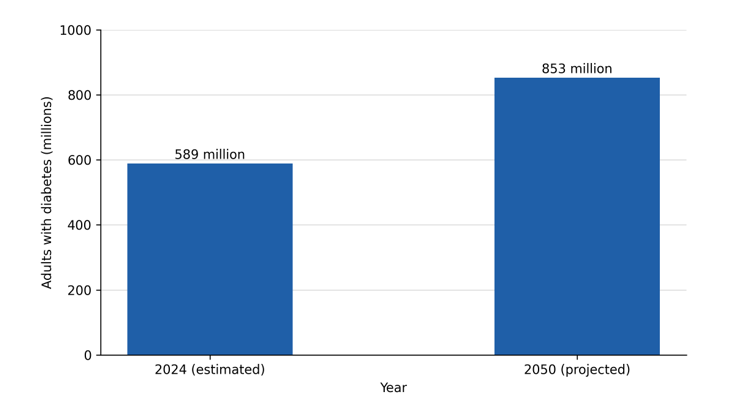
| Sample figure
Figure 1: Estimated Global Prevalence of diabetes in Adults (2025)
|
|||||||||||||
| List of references | Use the Harvard referencing style
At the end of the document, all sources cited in-text must be listed in alphabetical order by the author’s last name. Basic Format: Examples: Book: Smith, J. (2020). Introduction to Health Sciences. 2nd ed. London: Oxford University Press. Journal Article: Brown, K. & Green, T. (2018). ‘Impact of Nutrition on Mental Health’, Journal of Health Sciences, 25(3), pp. 45–60. https://doi.org/xxxx Website: World Health Organization (2021). Global Nutrition Report. Available at: https://www.who.int/nutrition (Accessed: 10 January 2022). |
||||||||||||
| In-Text Citations | Use the Harvard Style Text Citation
In-text citations in Harvard referencing follow the author-date format and are placed within the body of the text to acknowledge sources. Basic Format: (Author’s Last Name, Year) If directly quoting, include the page number: (Author’s Last Name, Year, p. xx) Examples: Paraphrasing: Research has shown that proper hydration improves cognitive function (Smith, 2020). Direct Quotation: According to Smith (2020, p. 45), “proper hydration significantly enhances cognitive performance.” Multiple Authors: Two authors: (Brown & Green, 2018) | Three or more authors: (Taylor et al., 2019) Citing an Organization: (World Health Organization, 2021) Citing Multiple Sources in One Citation: (Jones, 2017; Lee, 2019; Patel & Kumar, 2020 |
||||||||||||
| Headings |
|
||||||||||||
| Funding Statement | This section should consist of an acknowledgment of all funding sources that supported the submitted work, as well as any commercial association that could pose a conflict of interest or create a bias. | ||||||||||||
| Author Contributions | Please clearly describe the specific contributions made by each author to the manuscript. Use individual names or initials, and refer to roles such as: conceptualization, study design, data collection, data analysis, data interpretation, manuscript drafting, critical revision, supervision, and final approval. All authors listed must have made substantial contributions and should agree to be accountable for the content of the manuscript. | ||||||||||||
| Example:
Conceptualization: A.B., C.D.; Methodology: A.B., C.D.; Data Collection: A.B., E.F.; |
|||||||||||||
| Conflict of Interest | All authors should declare any relevant conflict of interest. | ||||||||||||
| Author Declaration | An author declaration form should be signed by all the authors involved to ensure their contribution. | ||||||||||||
| Plagiarism Policy | All authors are requested to check their manuscripts for plagiarism before submission. Manuscripts should not contain more than 20% of plagiarized matters. | ||||||||||||
| Ethical Responsibilities | The manuscript contents should be original and should not have been published elsewhere. | ||||||||||||
| Supplementary materials | Authors are encouraged to submit supplementary materials that support and enhance the understanding of the manuscript but are not essential to its presentation in the main text. Supplementary materials will be published online alongside the article and will not be included in the printed version of the journal.
Supplementary materials should be submitted as separate files and clearly labeled as Supplementary Table S1, Supplementary Table S2, Supplementary Figure S1, Supplementary Figure S2, etc.Each supplementary item should include a concise title and, where appropriate, explanatory notes. Supplementary materials must be cited in the manuscript in numerical order |
||||||||||||
| Article-processing Charges: Free of Charge | |||||||||||||